
 347-787-6824
Is Generative AI Fair Use?:
What the Courts Are Saying About AI and Copyright Infringement

Generative AI, OECD (Accessed Sept. 22, 2026), https://www.oecd.org/en/topics/generative-ai.html
On September 4, 2026, the Seattle Times filed a lawsuit against Microsoft and OpenAI, claiming that the tech giants illegally stole their articles to train their AI models ChatGPT, Microsoft Copilot, and Bing AI.[1] Together with Newsday, a Long Island-based newspaper, the Seattle Times alleged that Defendants bypassed Seattle Times’ and Newsday’s online paywalls to scrape content that they should have paid for.[2] Plaintiffs filed in federal court in the Southern District of New York, seeking that Defendants cease using and destroy any remaining copies of the illegally obtained articles.[3]
The action brought by the Seattle Times and Newsday is the latest in a line of lawsuits by American writers and copyright holders alleging that AI companies have engaged in copyright infringement on an unprecedented scale. Last year, the New York Times sued Perplexity AI, claiming that the tech startup was copying millions of its articles to train its AI products.[4] In July 2025, a group of authors settled a class action suit against Anthropic, the company behind the AI model Claude. The lawsuit settled for $1.5 billion, the largest payout in the history of US copyright law.[5]
These lawsuits also have major political implications. In September 2026, the US government weighed in for the first time on the question of AI and copyright. In a lawsuit titled In Re: OpenAI, Inc. Copyright Infringement Litigation,[6] the US threw its weight behind AI development. In a Statement of Interest filed on September 1, 2026 with the Southern District of New York, the US stated that it has a “strong interest in this court rejecting any argument that training LLMs on copyrighted texts violates copyright law.”[7] Its justification? International politics. Quoting President Trump, the brief emphasized the US’s commitment to “sustain and enhance America’s global AI dominance.”[8]
Seattle Times v. OpenAI: The Claims
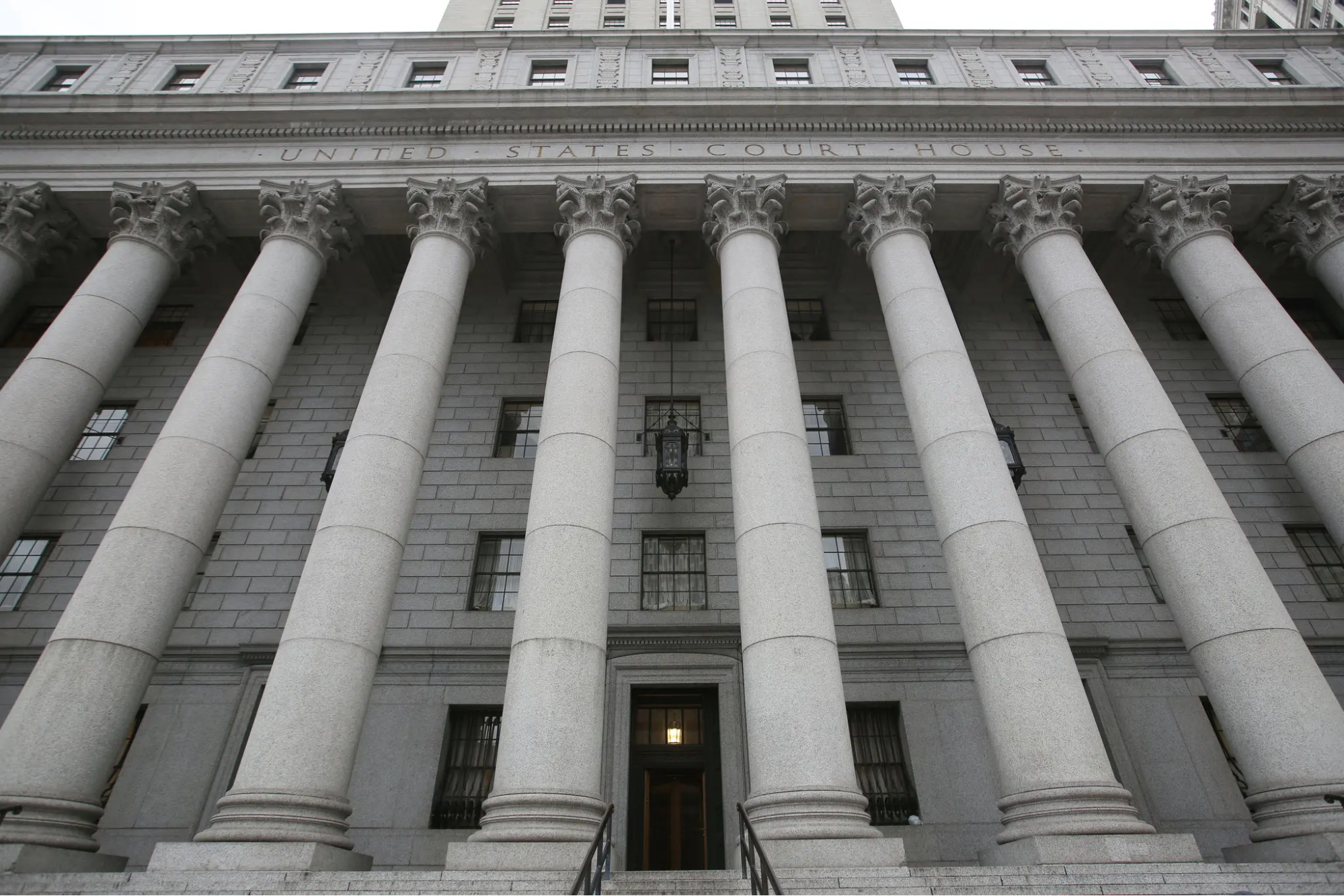
Hiroko Masuike, New York Times (Accessed Sept. 22, 2026) https://www.nytimes.com/2014/12/26/nyregion/a-new-york-court-celebrates-its-status-as-the-nations-oldest-but-others-arent-so-sure.html
But what are the courts actually saying? To answer that, a closer look at the claims brought by copyright holders is warranted. The latest lawsuit from the Seattle Times and Newsday provides an interesting case study.
The Seattle Times’ and Newsday’s copyright claims against OpenAI and Microsoft fall into two major categories. The first claim is copyright infringement, which is a violation of federal law codified under 17 U.S.C. § 501. The second claim is a violation of the Digital Millennium Copyright Act (“DMCA”). The DMCA is a portion of US copyright law amended in 1998 designed to address the rapidly-evolving relationship between copyright and the burgeoning Internet.[9]
17 U.S.C. § 501 provides that “[a]nyone who violates any of the exclusive rights of the copyright owner . . . is an infringer of the copyright or right of the author.”[10] In Seattle Times v. OpenAI, the Plaintiffs allege precisely that. The Seattle Times alleges that, “[b]y reproducing, storing, and processing copies of Plaintiffs’ works to build training datasets and to train, fine-tune, and ground Defendants’ GenAI models, and by disseminating generative output containing copies and derivatives of Plaintiffs’ works,” OpenAI and Microsoft have directly infringed on the Seattle Times and Newsday’s copyright.[11]
The Seattle Times also alleges a similar copyright violation under the DMCA. The DMCA, among other things, specifically protects a copyright holder’s “copyright management information” (“CMI”). CMI includes the name and title of the work as well as any authors of the work. The DMCA, at 17 U.S.C. § 1202, prohibits anyone from altering or removing CMI from any work or from distributing any work knowing that CMI has been removed. To prove copyright infringement under 17 U.S.C. § 1202, a plaintiff must show that a defendant knew that CMI was removed or altered, and that they knew its distribution would “induce, enable, facilitate, or conceal an infringement.”[12]
In their complaint, the Seattle Times and Newsday allege that OpenAI and Microsoft intentionally removed the Seattle Times’ and Newsday’s CMI from their works, and that OpenAI and Microsoft knew that doing so would “induce, enable, facilitate, or conceal infringement” of the Seattle Times’ and Newsday’s copyrights.[13] Plaintiffs also showed that by simply copy-and-pasting a Seattle Times article’s headline and URL into ChatGPT, the model returned nearly four paragraphs verbatim from the original article.[14]
Fair Use: A Limitation on Copyright Enforcement
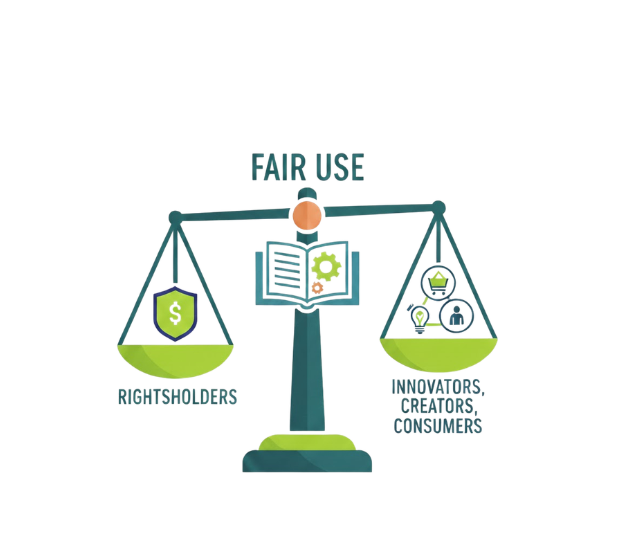
Fair Use Decoded, Re:Create Coalition (Accessed Sept. 22, 2026), https://recreatecoalition.org/resources/fair-use-decoded/
Despite the numerous copyright claims the Seattle Times has against OpenAI and Microsoft, the Defendants have a powerful defense: fair use. The fair use doctrine is a carve-out in US copyright law that allows for the use of copyrighted materials in certain contexts. Specifically, fair use protects the use of copyrighted materials for “purposes such as criticism, comment, news reporting, teaching . . . , scholarship, or research.”[15]
The rationale behind fair use is one of promoting innovation and free speech; it allows some flexibility in how courts must enforce copyright law, so that copyright does not “stifle the very creativity which that law is designed to foster.”[16] The law provides a four-factor test for courts to determine whether the use of a copyrighted work falls under fair use. Courts consider:
(1) the purpose and character of the use, including whether such use is of a commercial nature or is for nonprofit educational purposes;
(2) the nature of the copyrighted work;
(3) the amount and substantiality of the portion used in relation to the copyrighted work as a whole; and
(4) the effect of the use upon the potential market for or value of the copyrighted work.[17]
Fair use is an affirmative defense against an alleged infringing use. A defendant accused of copyright infringement need not claim that they didn’t violate a plaintiff’s copyright, only that they did so in a way that falls under fair use. If a court finds that fair use applies, the use is excused and can lead to the dismissal of the case entirely.[18]
Claiming fair use is the overwhelmingly popular defense for AI companies accused of copyright infringement.[19] And some courts are agreeing with them.
What Courts Are Saying: Bartz v. Anthropic

The Decision, New York State Unified Court System (Accessed Sept. 22, 2026), https://www.nycourts.gov/help/after-case-over/decision
Two significant cases, both coming from California federal court in June 2025, have come down with strong arguments in favor of finding fair use when AI companies use copyrighted works to train their large language models.
In Bartz v. Anthropic PBC, authors of copyrighted books brought a putative class action against Anthropic, claiming that Anthropic made unauthorized copies of their works and used those copies to train its large language model. Judge William Alsup, writing for the Northern District of California, analyzed Anthropic’s use of the authors’ works, weighing each of the four fair use factors, and ultimately decided that Anthropic’s usage fell under fair use.
Most significantly, the court found that OpenAI’s use was “quintessentially transformative.” Judge Alsup wrote that Anthropic’s large language model did not merely duplicate the authors’ works, but acted “[l]ike any reader aspiring to be a writer[.] Anthropic’s LLMs trained upon works not to race ahead and replicate or supplant them[,] but to turn a hard corner and create something different.”[20] The authors did not allege that Claude could directly produce copies of their work—thus, the court found no “traceable connection” between the model’s output and the authors’ works.[21]
The court also found that Anthropic’s use of the authors’ works would not have a detrimental effect on the value of their original works. The authors argued that the use of generative AI would lead to an explosion of competitive works, but the court did not agree. Judge Alsup wrote that the authors’ argument was “no different than it would be if they complained that training schoolchildren to write well would result in an explosion of competing works.”[22]
Judge Alsup found that all but one of the fair use factors favored Anthropic. Alsup granted summary judgment in favor of Anthropic on the issue of Anthropic’s use of copyrighted works in training data.
Pumping the Brakes: Kadrey v. Meta Platforms
While Judge Alsup came down conclusively in favor of AI, Judge Vince Chhabria, also a judge in California’s Northern District, cautioned against granting AI companies free rein to train their models on copyrighted material. Chhabria conducted the same four-factor fair use test in Kadrey v. Meta Platforms, an action brought by various copyright holders against Meta and its large language model, Llama.[23] While Judge Chhabria also held that Meta had successfully established a prima facie showing of fair use, Chhabria suggested a pathway for future plaintiffs to survive a motion to dismiss.
Chhabria agreed with Alsup that Meta’s use of copyrighted work to train its AI model was transformative. However, he disagreed with Alsup’s analysis of AI’s potential market effect. Chhabria argued that Alsup’s analogy equating AI to a horde of schoolchildren was “inapt.” “[W]hen it comes to market effects,” Chhabria wrote, “using books to teach children to write is not remotely like using books to create a product that a single individual could employ to generate countless competing works with a miniscule fraction of the time and creativity it would otherwise take.”[24] Chhabria noted that “[b]ecause the issue of market dilution is so important in this context, had the plaintiffs presented any evidence that a jury could use to find in their favor on the issue, factor four would have needed to go to a jury.” (emphasis added).[25]
Chhabria also acknowledged the implicit injustice in allowing AI companies to profit directly from the works of copyright holders while paying them nothing in return. “No matter how transformative LLM training may be,” Chhabria wrote, “it’s hard to imagine that it can be fair use to use copyrighted books to develop a tool to make billions or trillions of dollars while enabling the creation of a potentially endless stream of competing works.”[26]
Returning to Seattle Times v. OpenAI: What’s the News?
What does this mean for the Seattle Times and Newsday and their case against OpenAI and Microsoft? Plaintiffs likely have an uphill battle ahead of them, but there may be a few key factors that could turn the case in their favor.
Seattle Times’ first favorable fact is on the third factor: the amount and substantiality of OpenAI’s use. While the plaintiff authors in Bartz v. Anthropic did not submit any evidence that Claude could produce replicas of their copyrighted works, the Seattle Times does. In their complaint, they specifically allege that ChatGPT will regurgitate, verbatim, large parts of the Seattle Times and Newsday’s copyrighted material, effectively bypassing the newspapers’ online paywall.[27] Since the third fair use factor is primarily an analysis of the extent to which the allegedly infringing use functions as a competitor to the original work, the Seattle Times may have a better case than the plaintiffs in Bartz v. Anthropic.
Second, the Seattle Times has a blueprint for surviving a motion to dismiss, thanks to the opinion in Kadrey v. Meta Platforms. While not a binding authority, federal courts regularly look to other jurisdictions for instruction, particularly in cases of first impression. If the Seattle Times can produce a triable issue of fact that OpenAI has diluted the market for paid news sources, that showing may be sufficient to overcome a motion to dismiss on a fair use argument.
The future of AI development is on a high-speed collision course with existing copyright law, and only time will tell how—or if—both sides will weather the impact. Generative AI is a rapidly evolving market with trillions of dollars behind it, and proponents of AI growth may claim that copyright law must evolve or be left behind. But large language models are only as good as the data they are trained on. Ignoring the impact that training these models has on the people creating the works that serve as the foundation for these models is a convenient but unjust shortcut in the pursuit of tech and profit. Copyright law still has a place in ensuring that people are compensated for the works they produce. Judge Chhabria put it succinctly: “If using copyrighted works to train the models is as necessary as the companies say, they will figure out a way to compensate copyright holders for it.”[28]
[1] Chase DiBenedetto, OpenAI, Microsoft Face Copyright Lawsuit from Local Newspapers, Mashable (Sept. 6, 2026), https://mashable.com/tech/openai-microsoft-face-another-publishing-lawsuit.
[2] Complaint, The Seattle Times Company et al v. OpenAI Inc. et al, Docket No. 1:26-cv-07644 (S.D.N.Y. Sep 04, 2026).
[3] Seattle Times, Newsday sue OpenAI, Microsoft, alleging copyright infringement, Reuters (Sept. 4, 2026), https://www.reuters.com/legal/government/seattle-times-newsday-sue-openai-microsoft-alleging-copyright-infringement-2026-09-05/.
[4] Jaspreet Singh, New York Times Sues Perplexity AI for ‘illegal’ Copying of Content, Reuters (Dec. 5, 2025), https://www.reuters.com/legal/litigation/new-york-times-sues-perplexity-ai-infringing-copyright-works-2025-12-05/
[5] Blake Brittain, AI Copyright Battles Enter Pivotal Year as US Courts Weigh Fair Use, Reuters (Jan. 5, 2026), https://www.reuters.com/legal/government/ai-copyright-battles-enter-pivotal-year-us-courts-weigh-fair-use-2026-01-05/.
[6] In Re: OpenAI, Inc. Copyright Infringement Litigation, Docket No. 1:25-md-03143 (S.D.N.Y. Apr 11, 2025)
[7] Blake Brittain, US government backs OpenAI in New York Times copyright case, Reuters (Sept. 2, 2026), https://www.reuters.com/legal/litigation/us-government-backs-openai-new-york-times-copyright-case-2026-09-02/.
[8] Statement of the Interest of the United States, In Re OpenAI Copyright Infringement Litigation, Docket No. 1:25-cv-03483-SHS-OTW.
[9] The Digital Millennium Copyright Act, US Copyright Office (Accessed Sept. 22, 2026), https://www.copyright.gov/dmca/.
[10] 17 U.S.C § 501.
[11] Complaint, The Seattle Times Company et al v. OpenAI Inc. et al, Docket No. 1:26-cv-07644 (S.D.N.Y. Sep 04, 2026).
[12] Mango v. BuzzFeed, Inc., 970 F.3d 167, 171 (2d Cir. 2020).
[13] Complaint, The Seattle Times Company et al v. OpenAI Inc. et al, Docket No. 1:26-cv-07644 (S.D.N.Y. Sep 04, 2026).
[14] Id.
[15] 17 U.S.C. § 107.
[16] Andy Warhol Found. for the Visual Arts, Inc. v. Goldsmith, 598 U.S. 508, 527 (2023).
[17] 17 U.S.C. § 107.
[18] Bell v. Eagle Mountain Saginaw I.S.D., 27 F.4th 313, 320-21 (5th Cir. 2022).
[19] Blake Brittain, AI Copyright Battles Enter Pivotal Year as US Courts Weigh Fair Use, Reuters (Jan. 5, 2026), https://www.reuters.com/legal/government/ai-copyright-battles-enter-pivotal-year-us-courts-weigh-fair-use-2026-01-05/.
[20] Bartz v. Anthropic PBC, 787 F. Supp. 3d 1007, 1022 (N.D. Cal. 2025).
[21] Id. at 1030.
[22] Bartz, 787 F. Supp. 3d at 1032.
[23] Kadrey v. Meta Platforms, Inc., 788 F. Supp. 3d 1026 (N.D. Cal. 2025).
[24] Id. at 1036.
[25] Id. at 1060.
[26] Id.
[27] Complaint, The Seattle Times Company et al v. OpenAI Inc. et al, Docket No. 1:26-cv-07644 (S.D.N.Y. Sep 04, 2026).
[28] Kadrey v. Meta Platforms, Inc., 788 F. Supp. 3d 1026, 1036 (N.D. Cal. 2025).

